
Understanding environmental changes and catering to improved shrimp production
By Natthinee Munkongwongsiri and Pajaree Jueliang
The rainy season is one of the most challenging periods in shrimp farming. Production losses are often attributed to rainfall itself; however, rain is only the initiating event. The real challenge lies in the rapid environmental changes that follow, including reductions in temperature and salinity, fluctuations in dissolved oxygen (DO) and pH, changes in phytoplankton and microbial communities, and increased physiological demands on shrimp. These changes can challenge shrimp resilience and may create conditions that favour opportunistic problems (Buike, 2018; Huang et al., 2026).
Successful shrimp farming during the rainy season depends on anticipating environmental changes and adapting pond management early. This article explains the biological mechanisms behind rainy-season production challenges and provides a practical framework for adjusting management according to how the pond and shrimp respond.
Why is the rainy season so challenging?
Shrimp live entirely within their aquatic environment, so rapid changes in water quality directly influence their physiology and behaviour. Heavy rainfall can dilute salinity and alkalinity, lower water temperature, alter pH and DO, increase turbidity and disturb phytoplankton stability. Freshwater can also remain temporarily above more saline pond water, creating stratification until the pond is sufficiently mixed (Buike, 2018). The combination of simultaneous changes can place considerable physiological and ecological pressure on the production system (Table 1).
| Parameters | Typical response after heavy rain |
| Temperature | May decrease rapidly |
| Salinity | Declines through freshwater dilution |
| DO and pH | May decline or become unstable |
| Alkalinity/minerals | May decrease through dilution |
| Phytoplankton | Photosynthesis and bloom stability may decline |
| Organic matter/microbes | Distribution, decomposition and community structure may change |
Table 1. Changes on a production system with rain
Farming failure events during the rainy season
SyAqua’s 2025 commercial farm database (Figure 1) shows a seasonal pattern in reported failed farming events. These events increased from June and were highest from July to September, overlapping with the rainy season in several major shrimp-producing regions represented in the database. Health-related reports during this period included high mortality, caused by diseases like running mortality syndrome (RMS) and white spot syndrome virus (WSSV), alongside unknown and business-related causes of unsuccessful farming.
The data indicate an association between the rainy period and the increase in reported failed events, while the environmental mechanisms described below provide a plausible context for why this period deserves increased management attention.
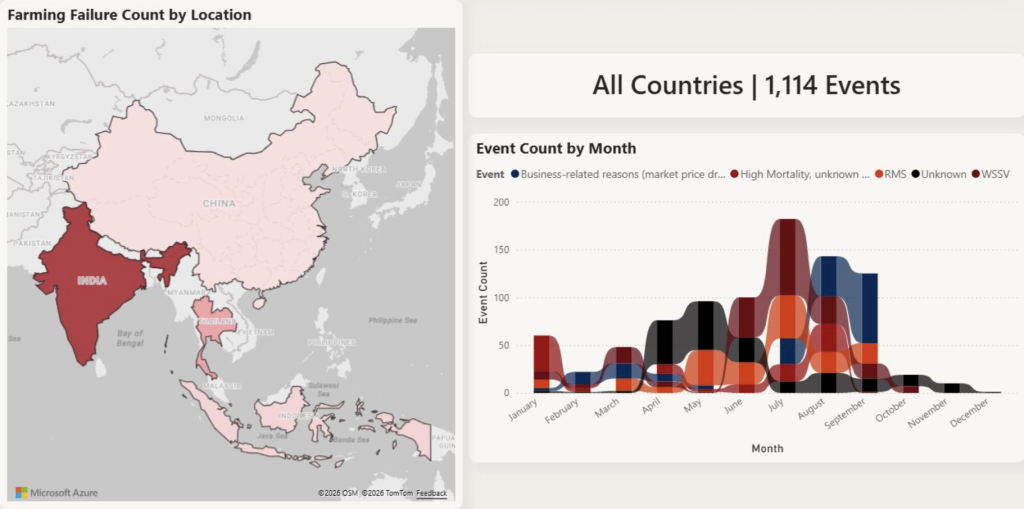
Figure 1 . Failed farming events by month in the 2025 SyAqua commercial farm database.
What happens after heavy rain?
Heavy rainfall introduces freshwater into the pond, reducing surface salinity and potentially creating temporary water-column stratification. Acute salinity reductions require Pacific white shrimp to make osmoregulatory and metabolic adjustments (Bückle et al., 2006; Wang et al., 2015). Cloudy weather and lower temperature can also alter metabolism, digestive activity and feeding response. At the same time, reduced sunlight limits phytoplankton photosynthesis, lowering daytime oxygen production and altering the normal pH cycle.
If feed input remains higher than what the shrimp can consume, uneaten feed, faeces, dead phytoplankton and other organic material can accumulate. Higher feed inputs increase nutrients and organic loading as well as oxygen demand, raising the risk of low DO and water-quality deterioration (Jescovitch et al., 2018). Together, changes in salinity, temperature, DO, phytoplankton and microbial balance can increase physiological demands on shrimp. The key concern is therefore the cascade of changes following rainfall, rather than rain as an isolated event.
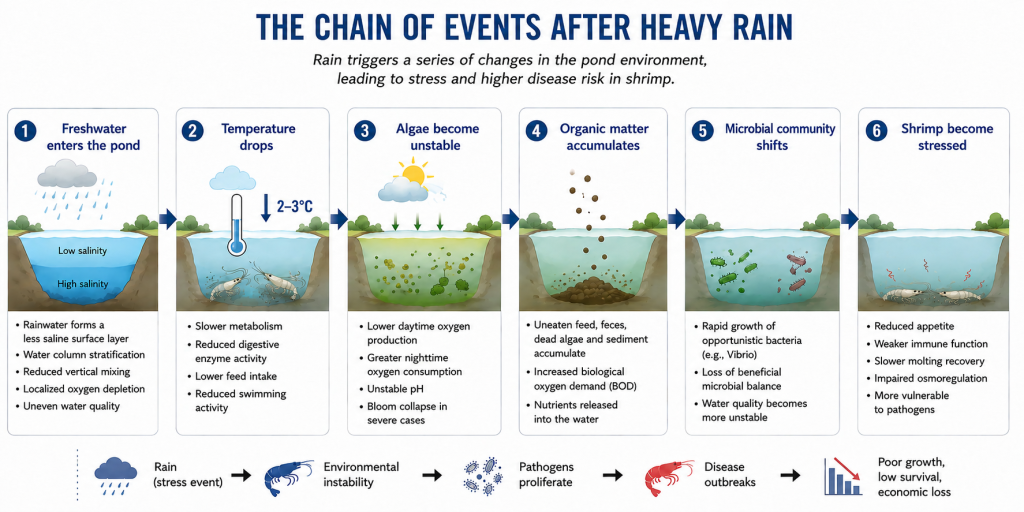
Figure 2. Simplified chain of pond changes following heavy rainfall, from freshwater input and environmental instability to increased physiological stress on shrimp.
Feed management during the rainy season
Feeding protocols provide a baseline for expected growth and consumption under relatively stable conditions (Figure 3). During heavy rain or rapid environmental change, actual feed demand may temporarily differ from the standard amount of feed fed to shrimp. A rapid temperature decline can alter metabolic and digestive activity and may change feeding response. SyAqua data indicate that feed demand may decline by approximately 3–5% for each 1°C reduction from 30°C to 20°C; this should be treated as a practical reference and confirmed against actual shrimp appetite rather than applied as a fixed rule.
The rule of thumb is not to reduce feeding automatically whenever it rains. Farmers should integrate weather, temperature, DO, salinity, check-tray response, shrimp activity and bloom condition. If appetite remains normal, an automatic feed reduction may not be necessary. When several warning signs occur together—such as reduced appetite, falling temperature and declining DO—a more conservative feeding response is appropriate.
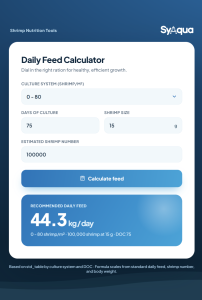

Figure 3. SyAqua’s daily feed calculator.
Practical feeding adjustments
Table 2 describes some observations and suggestions on when and how to adjust feeding to actual shrimp appetite. Farmers should reduce feed or delay feeding when conditions deteriorate, but maintain current levels when consumption remains normal. When several warning signs occur together, priority should be given to aeration and pond stabilisation before restoring feed amount gradually.
| Indicators | Observations | Recommended response |
| Forecast/rainfall | Heavy rain or prolonged cloud cover | Hold or slightly reduce the scheduled feed, then reassess before the next meal. |
| Temperature | Rapid decline, especially ≥2°C | Adjust feed to actual appetite, then restore it gradually as temperature and feeding activity recover. |
| DO | Declining or near the farm’s lower limit (e.g. ≤4 ppm) | Reduce or delay feeding, increase aeration, and reassess pond conditions. |
| Salinity | Rapid decline from normal (≥5 ppt per day) | Do not increase feed; monitor shrimp activity and appetite closely. |
| Check tray | More feed remains than usual | Reduce the next feeding and continue adjusting amounts to actual consumption. |
| Check tray | Normal consumption despite rain | Do not reduce feed automatically; maintain the current level cautiously and continue monitoring. |
| Bloom/pH | Rapid water-colour or pH-pattern change | Avoid large feed increases; monitor DO, pH, and alkalinity closely. |
| Multiple signs | Low appetite combined with changes in temperature, DO, or bloom condition | Apply a larger feed reduction or temporarily delay feeding and prioritise pond stabilisation. |
Table 2. What to look for and adjust feed and feeding with rain.
Maintaining pond stability beyond feeding
Feeding adjustment is only one part of rainy-season management. Aeration and water circulation are particularly important when reduced photosynthesis, increased oxygen demand and temporary water stratification occur. Adequate mixing can help maintain DO and restore more uniform pond conditions. Water-quality trends—including salinity, pH, alkalinity, DO and water colour—should be followed closely. Management should consider the direction and magnitude of change rather than reacting aggressively to a single measurement.
Phytoplankton stability
Phytoplankton stability also deserves attention during prolonged cloudy weather. A marked change in water colour, reduced daytime pH increase or declining DO may indicate bloom instability. Under these conditions, the priorities are to maintain oxygen availability, avoid unnecessary organic loading and monitor the pond closely until conditions stabilise.
Preparing for heavy rainfall
Many practical measures for preparing shrimp farms for heavy rainfall are already well established. These include maintaining drainage and dyke conditions, ensuring adequate aeration capacity, monitoring key water-quality parameters, adjusting feeding during unstable conditions, and maintaining aeration until pond conditions and phytoplankton recover (Buike, 2018). These practices remain important foundations of rainy-season management.
Building on these established practices, greater emphasis can be placed on farm readiness, trend-based decision-making, health preparedness and learning from each rainfall event.
More on adaptive rainy-season management
Rainy-season management is ultimately about understanding how each pond responds to environmental change. Established practices such as maintaining aeration, managing water quality and adjusting feeding remain essential, but the response should not be identical for every rainfall event. By combining reliable measurements, shrimp feeding response, multiple environmental indicators and records from previous events, farm teams can progressively build a better understanding of their own ponds and make more informed decisions throughout the rainy season (Table 3).
| Area | Additional field practice | Why it adds value |
| Equipment readiness | Calibrate DO, pH, salinity and temperature meters before the rainy season. | Reliable measurements are essential when pond conditions change rapidly. |
| Biomass × aeration capacity | Review expected biomass against normal and emergency aeration capacity. | Readiness should reflect actual crop oxygen demand, not simply whether aerators are available. |
| Pre-rain baseline | Record DO, pH, salinity, alkalinity, temperature, bloom condition and feeding response before expected heavy rain. | Provides a reference for judging the magnitude of change rather than individual values in isolation. |
| Trend-based decisions | Evaluate direction and magnitude across multiple observations rather than reacting to one reading. | Supports proportionate responses and helps avoid unnecessary correction. |
| Multiple-sign approach | Increase management attention when several indicators change together, such as appetite, temperature and DO. | Reflects the cascade of environmental changes described in this article. |
| Health readiness | Review biosecurity, health monitoring and response procedures before the higher-risk period. | Links environmental preparedness with the seasonal farming-failure pattern observed in SyAqua’s 2025 database. |
| Post-rain observation | Continue increased observation after rainfall even when visible conditions begin to improve. | Some pond and shrimp responses may continue after rainfall has stopped. |
| Farm learning | Record rainfall, pond response, management actions and subsequent crop response. | Builds farm-specific knowledge of how individual ponds respond to rainfall. |
| Next-event improvement | Review previous rainfall records when the next event is forecast. | Turns monitoring records into progressively better management decisions. |
Table 3. Measures and data collection for adapting rainy-season management
References
Alune, 2021. Preparing shrimp farms for wet weather. The Fish Site. 20 October 2021. https://thefishsite.com/articles/preparing-shrimp-farms-for-wet-weather-aquaculture-water-quality-indonesia
Bückle, L.F., Barón, B., Hernández, M. 2006. Osmoregulatory capacity of the shrimp Litopenaeus vannamei at different temperatures and salinities, and optimal culture environment. Revista de Biología Tropical 54(3): 745–753. https://doi.org/10.15517/rbt.v54i3.12773
Buike, P. 2018. Rainy season effects on shrimp grow-out ponds. Responsible Seafood Advocate, 11 June 2018. https://www.globalseafood.org/advocate/rainy-season-effects-on-shrimp-grow-out-ponds/
Jescovitch, L.N., Ullman, C., Rhodes, M. Davis, D.A. 2017. Effects of different feed management treatments on water quality for Pacific white shrimp Litopenaeus vannamei. Aquaculture Research 49(1): 526–531. https://doi.org/10.1111/are.13483
Wang, X. et al. 2015. Molecular pathway and gene responses of the Pacific white shrimp Litopenaeus vannamei to acute low salinity stress. Journal of Shellfish Research 34(3): 1037–1048. https://doi.org/10.2983/035.034.0330