
Given the growing challenges in farming environments, achieving sustainable and profitable shrimp production in Asia requires resilient post larvae
Global shrimp production continues to grow, with major producers such as Ecuador, India, China, Vietnam and Indonesia expanding output to meet rising demand. At the same time, shrimp farming is becoming increasingly complex. Disease pressure, environmental variability, tightening biosecurity requirements and rising feed costs are placing greater emphasis on consistency and risk management rather than maximum growth alone.
Shrimp seed quality matters
Particularly in Asia, shrimp are farmed across highly diverse salinity ranges, pond systems and management styles. Recent data from across Asia showed a significant percentage of ponds are being flushed or crops harvested early due to slow growth, high mortality rates and disease outbreaks. The financial toll from lost crops is substantial, compromising farm viability. Under these conditions, the quality of shrimp post larvae (PL) — especially their robustness and resilience—has become a critical factor in farm performance. Consistency in survival, adaptability and feed efficiency now rank alongside growth as core performance indicators.
As a result, shrimp breeding programs and hatchery systems are evolving toward integrated, science-based approaches that link genetics, hatchery technology and performance data across the production chain.
Genetics and building resilient shrimp post larvae
In modern shrimp farming, genetics defines far more than growth rate. As farming environments become more variable and challenging, and production risks increase, breeding objectives must focus on producing shrimp post larvae seed that perform consistently under commercial conditions despite these challenges.
Earlier breeding approaches often prioritised rapid growth, assuming this alone would drive farm success. Experience has shown that such single-trait selection for growth frequently leads to trade-offs, particularly reduced robustness and lower tolerance to stress or disease. Shrimp that perform well under ideal conditions may struggle when exposed to fluctuating salinity, water-quality challenges or pathogenic pressure.
To overcome this, advanced breeding programs now apply balanced genetic strategies that improve multiple traits simultaneously. High genetic diversity provides the foundation for long-term improvement, while quantitative genetics and genomic selection increase accuracy and rate of genetic improvement for combinations of complex traits. Index-based selection allows growth, survival, robustness, and disease tolerance to be improved together rather than in isolation.
From genetic design to commercial farm performance
Balanced breeding strategies must ultimately prove their value under commercial farming conditions. Genetic programs designed for resilience must therefore deliver consistent performance not only when farming conditions are optimal but also under farm-level stress conditions.
‘These trends are supported by multi-country commercial production records generated through structured benchmarking programs, including datasets developed within SyAqua’s commercial farming network.’
Breeding programs that deliberately select and test shrimp across different salinity environments have demonstrated that strong performance can be maintained across low-, medium- and high-salinity systems. Rather than producing environment-specific lines, balanced genetic strategies allow a single genetic line to perform reliably across diverse farming conditions.
Disease pressure represents an additional and often disruptive source of production risk. While different genetic stocks may show similar growth and feed conversion under non-challenged conditions, clear differences emerge when shrimp are challenged by the presence of disease pathogens. Controlled-challenge testing shows that genetically tolerant stocks maintain significantly higher survival, better growth and improved feed efficiency under disease pressure. This tolerance has been demonstrated for viruses as well as bacterial and fungal pathogens such as acute hepatopancreatic necrosis disease (AHPND) and Enterocytozoon hepatopenaei (EHP).
Commercial farm data confirms the practical value of these traits. Across ponds facing variable environmental and health challenges, balanced genetic lines show more stable growth, efficient feed conversion and consistent yields. Performance trends remain similar across environments rather than diverging sharply, reducing uncertainty for farmers and feed producers.
These trends are supported by multi-country commercial production records generated through structured benchmarking programs, including datasets developed within SyAqua’s commercial farming network.
Genetic integrity and traceability
As breeding programs become more sophisticated, maintaining genetic integrity and traceability throughout the production chain is increasingly important. Unintentional hybridisation, genetic drift or misidentification of stocks can compromise performance outcomes and reduce confidence in production results.
This issue is particularly relevant for farmers sourcing post larvae from hatcheries that manage multiple genetic stocks. Without reliable verification, it can be difficult to link on-farm performance—such as survival, growth or feed conversion—to a specific genetic line. This uncertainty complicates management decisions, feed evaluation and comparisons between production cycles.
Genomic tools now allow reliable verification of genetic identity using small sample sizes collected at the farm level. Proper sampling protocols and secure data handling ensure confidentiality while providing statistically robust differentiation between genetic lines. This enables farmers to confirm that the post larvae stocked in ponds match the intended genetic source (Figure 1).
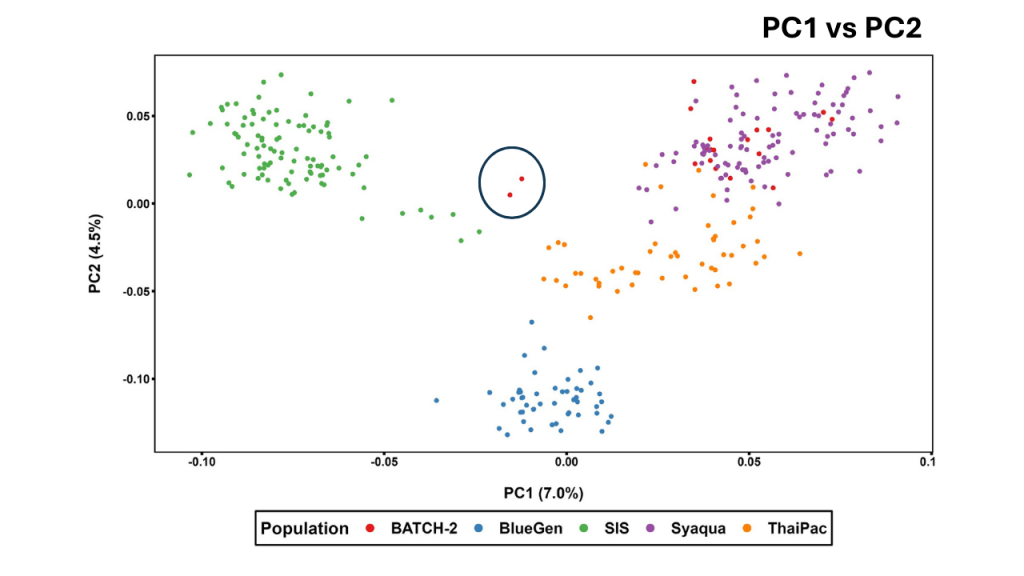
Figure 1. Genomic analysis enables reliable statistically powerful differentiation of SyAqua from non-SyAqua or hybrid stocks.
Hatchery systems to unlock genetic potential
Genetic improvement alone does not guarantee performance. The expression of genetic potential depends heavily on hatchery systems and management practices. Poor hatchery execution can mask genetic advantages, resulting in variable post larvae quality and inconsistent farm performance.
Key hatchery elements that support high-quality post larvae production include:
- Strong biosecurity and water treatment systems
- Effective bioremediation and water quality management
- High-quality fresh and formulated feeds
- Feeding strategies aligned with larval developmental needs
Larval feeds are critically important, from healthy algae to clean, enriched Artemia with little or no Vibrio contamination and high-quality manufactured larval feeds. Hatcheries have many choices in larval feeds from low-cost flakes to the most advanced, highly digestible and nutritionally balanced microencapsulated particles.
In a well-managed hatchery, high-quality feed improves profitability by increasing survival rates and enhancing post larvae quality. Feed management is particularly critical. Overfeeding does not improve larval performance and often leads to deteriorating water quality and compromised health. Successful hatcheries rely on frequent observation of survival, gut fullness and larval condition, adjusting feeding rates accordingly rather than following fixed feeding plans.
Measuring and assuring post larvae quality
Post larvae quality cannot be assumed—it must be measured. Comprehensive post larvae quality assessment programs typically include:
- Morphological assessments for size consistency, deformities, fouling and tissue damage
- Evaluation of physiological indicators such as lipid reserves
- Stress tests and stocking accuracy checks
- Pathogen screening using molecular and microbiological tools
- Continuous monitoring of key water quality parameters
Coupled with new AI-based tools for measuring and quantifying post larvae, these assessments provide hatcheries and farmers with greater confidence in the quantity and quality of seed entering grow-out systems. Ensuring that the pond is stocked with the correct number of post larvae is critical for proper pond management. Even small improvements in post larvae quality can translate into significant gains in survival, growth, and feed conversion efficiency at the farm level.
‘Investing in high-quality shrimp post larvae delivers returns that far outweigh the initial cost.’
Conclusion: investing in post larvae quality pays dividends
Shrimp farming success increasingly depends on integrating genetics, hatchery technology, and data-driven decision-making. Advances in genomic selection, combined with balanced breeding strategies and modern hatchery systems, enable the production of post larvae that are not only fast-growing but also robust, disease-tolerant and efficient feed users.
For industry, the message is clear: investing in high-quality shrimp post larvae yields returns that far outweigh the initial cost. As farming environments become increasingly challenging, resilient post larvae will form the foundation of sustainable and profitable shrimp production worldwide.