
Commercial farm data show that reducing dietary protein can maintain shrimp performance while improving feed efficiency, profitability and environmental sustainability
By Dr. Lumpan Poolsawat, Dr. Natthinee Munkongwongsiri and Dr. Craig L. Browdy
Protein is one of the most expensive components in shrimp feed, yet it is often used at levels higher than what shrimp actually require. Many farmers believe that higher protein diets will always result in better growth and higher production. But is this really true under commercial farming conditions?
A recent multi-pond evaluation conducted in Thailand provides new insights that challenge this long-standing assumption.
Rethinking protein in shrimp diets
For many years, shrimp farmers have relied on high-protein diets—typically 38–45% crude protein (CP)—to support growth and production. This approach is based on the belief that higher protein levels directly translate into better performance.
However, rising feed costs and increasing pressure to improve sustainability are challenging this assumption. The key question is no longer how much protein can be fed, but how much is actually required to achieve optimal results.
Evaluating feeding strategies under commercial conditions
To better understand the impact of dietary protein levels, three feeding strategies were evaluated across 76 commercial ponds in Thailand during 2025–2026:
- High protein (HP): 38% CP throughout the culture cycle
- Low protein (LP): 35% CP throughout the cycle
- Step-down strategy (HP+LP): 38% CP during early stages (DOC 1–30), followed by 35% CP until harvest
All ponds were selected based on good management practices, stable performance history, and absence of major disease outbreaks to ensure reliable comparisons.
Unlike laboratory trials, this evaluation reflects real farm conditions, making the results directly applicable to commercial shrimp production.
Comparable performance across protein levels
Results showed no significant differences among feeding strategies in key performance indicators, including:
- Average daily growth (ADG)
- Survival rate
- Feed conversion ratio (FCR)
- Yield
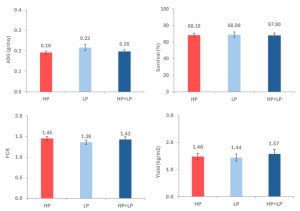
Figure 1: Comparison of growth performance (ADG, survival, FCR) across feeding strategies
These findings demonstrate that increasing dietary protein beyond a certain level does not necessarily improve shrimp performance.
For farmers, this means that higher protein diets may not provide additional production benefits when shrimp nutritional requirements are already met.
Improved nitrogen utilization efficiency
Although growth performance was similar, shrimp fed lower protein diets showed significantly improved nitrogen conversion efficiency (NCE).
Both LP and HP+LP groups utilized dietary protein more effectively, converting a greater proportion into biomass rather than losing it as waste.
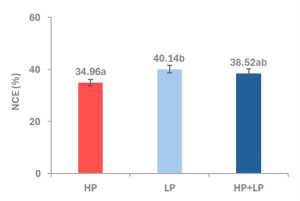
Figure 2: Nitrogen conversion efficiency (NCE) showing improved protein utilization in LP and HP+LP groups
This improvement has important practical implications:
- Reduced feed cost due to lower protein inclusion
- Lower nitrogen discharge into pond systems
- Improved water quality management
In contrast, excess protein in high-protein diets is often inefficiently used and contributes to nitrogen accumulation and water quality deterioration in the culture environment.
Aligning feed strategy with shrimp biology
The step-down feeding strategy provided particularly valuable insights.
Shrimp fed high protein during early development and lower protein during later stages achieved:
- Equivalent growth and survival
- Improved nutrient utilization
- A trend toward higher profitability
This reflects the biological development of shrimp.
In early stages, shrimp have limited digestive capacity and require higher nutrient density. As they grow, their digestive system becomes more efficient, allowing them to utilize nutrients more effectively—even at lower protein levels.
This suggests that protein requirements should be adjusted dynamically throughout the culture cycle rather than applied uniformly.
Economic and sustainability advantages
Optimizing protein levels offers both economic and environmental benefits.
From a cost perspective, reducing protein inclusion lowers feed formulation costs, which represent a significant portion of total production expenses.
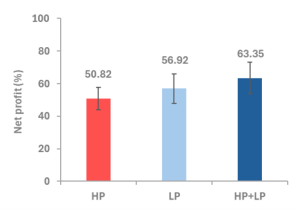
Figure 3: Net profit comparison among feeding strategies
From an environmental perspective, improved nitrogen utilization reduces waste output, helping maintain better pond conditions and reducing the risk of water quality-related stress.
Together, these benefits support a more sustainable and resilient shrimp production system.
Practical implications for farmers
The results of this study highlight several key takeaways for shrimp farmers:
- Higher protein diets do not always improve performance
- Lower protein diets can maintain growth, survival and yield
- Stage-based feeding strategies can improve efficiency
- Optimizing protein levels can enhance profitability and sustainability
Rather than focusing on feeding more protein, farmers should focus on feeding the right amount of protein at the right stage of shrimp development.
Conclusion
This multi-pond evaluation demonstrates that reducing dietary protein levels does not compromise shrimp performance under well-managed commercial conditions.
Low-protein and step-down feeding strategies maintained growth, survival and profitability comparable to high-protein diets while significantly improving nitrogen utilization efficiency.
These findings highlight the importance of optimizing protein levels to achieve more cost-effective and environmentally sustainable shrimp production.