
The global shrimp industry is evolving rapidly, with farming operations expanding from traditional coastal ponds to inland, brackish, and even freshwater environments. Penaeus vannamei, a euryhaline species is well known for its ability to grow across a wide salinity range, from near-freshwater conditions to highly saline, arid regions exceeding 50 ppt.
However, shrimp farming at lower salinities introduces physiological challenges. Shrimp must expend energy on osmoregulation, maintaining internal salt balance especially when external salinity deviates from their optimal range. The ideal salinity balance point for P. vannamei is approximately 24.7 ppt (Castille and Lawrence, 1981; Li et al., 2015). As external salinity shifts away from this value, more energy is diverted from growth and feed utilization toward maintaining internal homeostasis.
Importantly, the efficiency of osmoregulation is under genetic control. Some shrimp families regulate internal salt balance more effectively, allowing them to grow faster and convert feed more efficiently, even in challenging low-salinity environments. This makes broad salinity tolerance a highly valuable trait when developing genetically improved shrimp lines.
Recognizing this need early, SyAqua committed to developing a genetic selection strategy incorporating breeding for broad salinity tolerance and consistent performance. Applying our balance selection strategies SyAqua simultaneously measures and improves performance for multiple traits while minimizing inbreeding and potentially negative interactions. This article highlights how exclusive R&D and large-scale farm validation demonstrate that SyAqua genetics provide accurate, precise, and stable outcomes across a wide variety of salinity zones, with minimal performance variation between environments.
Selection and Laboratory Testing for Salinity Adaptability
Starting in 2017, SyAqua launched a dedicated breeding program targeting shrimp performance under both high salinity (~30 ppt) and low salinity (~5 ppt) conditions.
Rather than selecting for salinity-specific lines, SyAqua focused on building robust, versatile genetics capable of thriving across environments.
Key outcomes from internal trials include:
- 44% improvement in ADG under low salinity conditions across 9 generations.
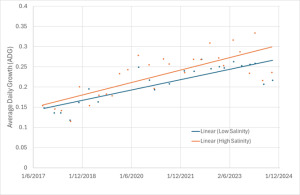
Figure 1: Average daily growth of SyAqua genetics tested in high and low salinity tested from multiple batched across 9 generations during 2017 – 2024.
- 22% increase in survival rates under low salinity conditions.
- High phenotypic (0.55–0.75) and genetic correlations (0.75–0.93) between growth traits at high and low salinities — ensuring genetic stability and predictability.
These strong genetic linkages provided the basis for selection decisions assuring that the selected families could deliver consistent improvements and high performance across multiple salinity environments, without the need for specialized or segmented shrimp lines.
Commercial Validation: Consistent Outcomes Across 98 Commercial Ponds
In 2024, SyAqua tested this breeding philosophy at scale, analyzing real-world performance across 98 spanning high (>25 ppt), medium (16–25 ppt), and low (6–15 ppt) salinity ranges. Only ponds with normal harvest cycles and no acute health issues were included in the dataset for performance analysis.
Table 1: Average performance across 3 salinity ranges in commercial farms.
| Salinity Level | Number of ponds | Days of Culture | Stocking density (PL/m2) | Final ADG (g/day) | Yield
(Kg/m²) |
Survival Rate (%) | FCR |
| >25 ppt | 28 | 88 days | 78 | 0.20 | 1.13 | 80% | 1.33 |
| 16–25 ppt | 52 | 87 days | 85 | 0.21 | 1.28 | 79% | 1.29 |
| 6–15 ppt | 12 | 90 days | 88 | 0.22 | 1.51 | 86% | 1.19 |
Key Observations:
- Average Daily Growth (ADG) remained remarkably consistent across salinity levels, ranging narrowly from 0.20 to 0.22 g/day, reflecting strong stability in SyAqua’s genetic line.
- Yield were highest in low salinity ponds due to slightly higher stocking densities and survival rates. However, all salinity groups showed comparable and reliable production outcomes.
- Survival rates stayed high and stable across conditions (79–86% range).
- Feed Conversion Ratios (FCRs) varied somewhat between farms but remained efficient in all environments.
Performance variation across different salinity levels was minimal, confirming that SyAqua balance line animals maintain stable and profitable performance levels under diverse salinity conditions as designed by the genetic selection strategy.
Bridging Laboratory Models to Real-World Success
The direct alignment between internal controlled trials and commercial farm outcomes provides strong evidence for the effectiveness of SyAqua’s balanced genetic approach.
- The stability and consistency of performance of SyAqua balance line across salinities was confirmed over many ponds across many farms in 2024.
- Laboratory tests correlating performance between high and low salinity environments enabled selection of the fast-growing strains. Pond data confirmed that laboratory-based predictions were accurately reproduced on farms.
- No major trade-offs were observed in growth, survival, or feed efficiency across the salinity gradient in well managed farm ponds.
- Farmers across different geographies can expect predictable, high-quality results with SyAqua balance line in well managed ponds.
In short, SyAqua genetics deliver what they promise: stable, adaptable, and profitable shrimp performance across all salinities.
Practical Advantages for Farmers
For shrimp producers, this consistency translates into major operational benefits:
- Broader farming flexibility: Stock shrimp in freshwater, brackish, or seawater ponds with confidence.
- Reduced production risk: Stable survival and growth minimize the impact of environmental changes.
- Higher and more predictable returns: Efficient feed usage and strong yields across salinities improve profitability.
As global shrimp farming continues to diversify, SyAqua is committed to providing a leadership role in development and application of reliable genetics across environmental extremes.
Conclusion
Through a combination of effective R&D, well managed and consistent breeding strategies and large-scale, real-world validation, SyAqua has developed shrimp genetics capable of delivering consistent high performance across the full range of salinity conditions. By measuring and selecting for multiple traits simultaneously using advanced genomic techniques, gains can be achieved steadily and consistently even for traits which may be negatively correlated. The key is a focused, data driven, disciplined and consistent approach applied across many generations. With minimal variation in growth, survival, and FCR across high, medium, and low salinity environments, SyAqua shrimp offer unparalleled consistency, flexibility and reliability for today’s farmers.
“Wherever your farm is, SyAqua shrimp are ready to thrive.”